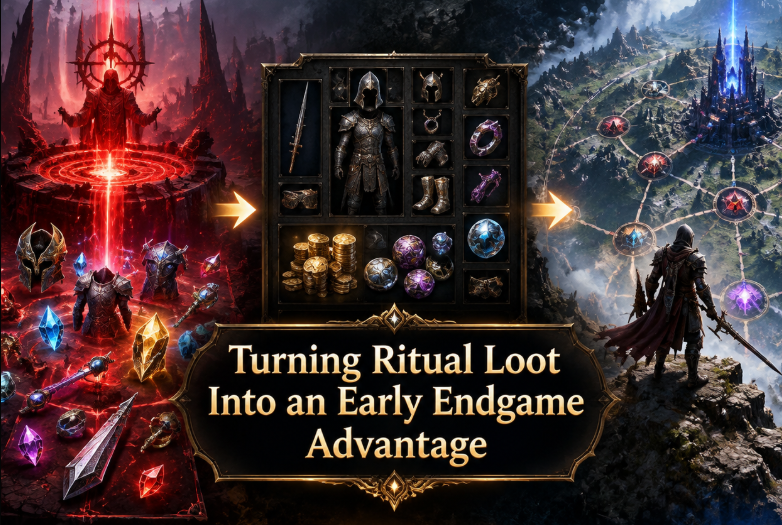
Finishing the campaign is only the beginning in Path of Exile 2. If you have been clearing Forbidden Rites along the way, your stash should already contain a mixture of Exalted Orbs, rare equipment, and possibly a few useful Uniques.
The important thing now is turning those drops into a strong starting setup for maps. You do not need perfect gear. You need a character that is stable, efficient, and ready to start generating better loot.
Sort Your Stash Before Entering Maps
Do not rush into maps with a completely full inventory and a stash full of random campaign items.
Start by separating your gear into three groups: equipment you will use immediately, items worth keeping, and everything else.
Your first priority is your main weapon or damage source. If your weapon is still a campaign-level item, this is usually the first place to spend resources.
Next, check your defensive gear. Resistances, life, energy shield, armor, evasion, and useful attributes can matter more than a small amount of extra damage.
You should also check your boots. Good movement speed can make early mapping feel dramatically smoother because you will be moving between packs constantly.
Spend Currency on Problems, Not Perfection
The first few maps are not the time to build a perfect endgame character.
Use your accumulated POE2 Currency to solve obvious weaknesses. If your resistance is too low, fix it. If your weapon damage is falling behind, upgrade it. If you are dying to basic monster packs, improve your defenses before adding another small damage modifier.
This approach keeps your spending controlled.
A common beginner mistake is trying to upgrade every slot at once. That quickly consumes your entire stash without creating a meaningful improvement.
Instead, identify the two or three weakest pieces and focus your resources there.
Keep Useful Uniques
Do not immediately sell every Unique that does not fit your current build.
Some Uniques become useful when you change builds, while others can be valuable to other players. If you are unsure about an item, keep it temporarily and check whether it has a realistic use before getting rid of it.
At the same time, do not fill your entire stash with every Unique you find. Duplicate low-value items can be sold or traded once you are confident they have no purpose.
The same rule applies to rare equipment. Keep rares with combinations of strong defensive or offensive modifiers, but avoid hoarding every item that looks slightly better than your current gear.
Build a Small Currency Reserve
Going into maps with zero currency is uncomfortable.
Keep some resources available for emergency crafting and gear replacement. You will inevitably find an item that needs one more modifier, discover a resistance problem, or need to replace a piece after changing another slot.
Having a reserve also gives you flexibility when an unexpectedly strong item appears.
Do not spend everything on your first weapon upgrade simply because you finally have enough currency to afford it.
Your First Mapping Priorities
Once your character is ready, focus on content that gives useful progression rather than chasing the most complicated rewards immediately.
Your first objective should be establishing a stable mapping rhythm. Learn how quickly your build clears, how much damage it can safely take, and which enemy types cause problems.
Then start improving the areas that provide the best returns for your build.
Fast clear speed matters because more completed encounters mean more opportunities for currency and equipment. Survival matters just as much. A character that clears slightly faster but dies regularly will usually lose more time than it gains.
Turn Early Drops Into Future Upgrades
Your campaign loot should be viewed as seed capital.
A good rare can become your first mapping weapon. An unwanted Unique can become trade value. Extra crafting currency can turn an average item into something usable.
This is how your early economy starts growing.
You may eventually see websites advertising POE 2 Currency for sale, but external purchases are not necessary for building your first mapping setup. Learning how to evaluate drops and spend efficiently is much more valuable in the long run.
The First Real Goal
Do not aim for a perfect build immediately after finishing the campaign.
Aim for a setup that can clear early maps comfortably and consistently.
Once your defenses are stable, your main damage skill is performing well, and you have a small currency reserve, start pushing forward. Every successful map gives you another chance at better bases, stronger rares, valuable currency, and build-defining Uniques.
That is the real advantage of good Forbidden Rites preparation: you enter the endgame ready to improve instead of spending your first few hours repairing problems that should have been fixed before mapping.