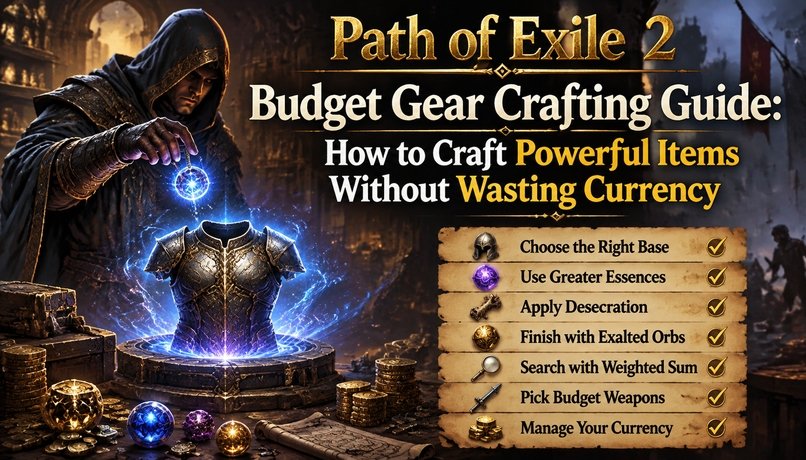
In Path of Exile 2, upgrading your equipment is essential for progressing through the campaign and tackling difficult endgame content. However, spending too much POE2 Currency on every gear upgrade can quickly drain your resources, especially during the early stages of a new league. Instead of chasing expensive endgame items, players can use budget crafting techniques to create powerful equipment, improve their characters, and even earn currency by selling successful crafts.
The key is understanding which modifiers matter, choosing affordable item bases, and using crafting currency efficiently. With the right approach, you can build reliable equipment without investing a fortune in every item slot.
1. Start With the Right Magic Item Base
Successful budget crafting begins with a good magic item base. Ideally, the item should already have at least one useful modifier. Finding two desirable modifiers makes the process even better because it reduces the amount of additional crafting required.
Different equipment slots have different priorities:
- Boots: Movement speed and elemental resistances.
- Gloves: Flat damage and useful resistance modifiers.
- Rings: Flat damage, elemental damage, and resistances.
- Helmets: Defensive modifiers and elemental resistances.
- Body Armour: Life or other useful defensive modifiers.
- Weapons: Damage, critical hit chance, attack speed, or skill levels depending on the build.
There are two practical ways to obtain suitable bases. You can purchase magic items directly from the trade market or collect useful white bases and upgrade them yourself.
During the early stages of a league, picking up valuable white bases is often a good way to conserve currency. Use Transmutation Orbs and Augmentation Orbs to roll modifiers until you find a combination worth developing.
Item level is another important consideration. Higher-level bases can access stronger modifiers, but you do not always need the highest possible item level to create useful equipment.
For example, item level 71 provides access to Tier 2 resistance modifiers, while item level 75 unlocks several valuable options, including Tier 1 flat damage on rings and gloves, additional skill levels on amulets, and Tier 2 elemental damage modifiers on weapons.
Understanding these breakpoints helps you decide which bases deserve your crafting materials.
2. Craft Affordable Armour With Greater Essences
Once you have a suitable magic base, the next step is adding a guaranteed modifier with a Greater Essence.
For resistance-focused armour, Greater Essences that provide fire, cold, lightning, or chaos resistance are particularly useful. Choose the resistance that your character needs most.
For example, if your boots already have cold resistance, using a Greater Essence that adds fire resistance can create a useful defensive combination.
The Greater Essence upgrades the magic item into a rare item while guaranteeing its specific modifier. Compared with lower-tier versions, Greater Essences provide access to better modifier tiers or rolls.
After applying the essence, remember that the item now has a crafted modifier. Under the crafting approach described here, each item can normally have only one crafted modifier, so you need to plan the remaining steps carefully.
The next stage involves desecration currency.
3. Use Desecration to Add Valuable Resistance Modifiers
Desecration is an important part of this budget crafting strategy because it provides another opportunity to obtain useful modifiers without relying entirely on random exalted slams.
For armour, Preserved Ribs allow you to desecrate a rare item. Combining them with an Omen of Dextral Necromancy guarantees that the added desecrated modifier will be a suffix.
Rare equipment can have up to three prefixes and three suffixes. Therefore, managing the available modifier slots is essential when planning your craft.
After desecration, take the item to the Well of Souls to reveal the hidden modifier. You will receive three random suffix options and can select the one that best supports your build.
If you want additional chances, an Omen of the Abyssal Echoes can reroll the available options, giving you another three possibilities.
For armour, resistance modifiers are usually excellent choices because they benefit almost every build. They are also attractive to other players, particularly during the early stages of a league when affordable defensive upgrades are in high demand.
However, do not spend excessive currency trying to force a perfect result. If the desecration misses your desired resistance, you can still sell the item or repeat the crafting process with another base.
The goal is to maintain a reasonable crafting cost rather than turn every attempt into an expensive project.
4. Finish Rare Gear With Exalted Orbs
Once the main modifiers are in place, Exalted Orbs can help complete the item.
Regular Exalted Orbs add a random modifier to a rare item. Greater Exalted Orbs work similarly but restrict the available modifiers to those with a minimum level of 35, improving the opportunity to obtain higher-tier modifiers.
If your desecrated modifier is successful, you can activate an Omen of Greater Exaltation before using a Greater Exalted Orb. This provides two random modifiers to finish the craft.
If the desecration result is not particularly valuable, you can choose to list the item for sale or use two regular Exalted Orbs to fill the remaining modifier slots.
These final modifiers involve some randomness. You might obtain two excellent upgrades, or you might receive combinations that are less attractive.
That uncertainty is exactly why keeping the initial crafting cost low matters.
A successful item could become a major character upgrade or sell for multiple Divine Orbs. Even unsuccessful crafts may retain enough value to recover part of your investment.
5. Use Weighted Sum to Find Cheap Trade Bases
Crafting efficiently is only half the process. Knowing how to search the trade market can save just as much currency.
One particularly useful feature is the Weighted Sum filter.
Weighted Sum allows you to assign different numerical values to modifiers based on how important they are to your build. This makes it possible to compare items with different modifier combinations through a single search.
Consider a bow with fire, cold, and lightning damage. If lightning damage is twice as valuable to your build, you can assign it a weight of two while giving fire and cold damage a weight of one.
The trade filter calculates the weighted value of each modifier and combines the results into a total score.
You can then set a minimum Weighted Sum to exclude items that do not meet your requirements.
This is especially helpful when searching for elemental resistances. Instead of checking fire, cold, and lightning resistance separately, you can use the combined pseudo elemental resistance modifier to find equipment with a suitable overall resistance value.
However, remember that different modifiers have different possible numerical ranges. A modifier with a higher maximum value is not automatically more valuable to every build.
For more accurate comparisons, use a trade search that accounts for the actual ranges of each modifier.
This approach allows you to compare multiple combinations of desirable stats without restricting your search to one exact item configuration.
6. Choose Budget Weapons Instead of Chasing Expensive Physical Bases
Weapons deserve special attention because they are often one of the biggest sources of character damage.
Many players immediately prioritize expensive physical damage weapons, particularly when preparing for endgame content. Physical damage is extremely valuable for certain builds, but it is not necessarily the most economical choice during early progression.
Consider a situation where a physical damage weapon costs one Divine Orb while an elemental damage alternative costs only one Chaos Orb.
If both provide similar damage for your particular skill setup, the cheaper weapon may be the better investment.
Of course, the right choice depends on your build.
Skills such as Hammer of the Gods and Stampede generally benefit from prioritizing physical damage. Meanwhile, skills such as Ice Shot and Twister can potentially use elemental damage as a budget alternative, depending on their setup and scaling.
Lightning damage can also provide shock, increasing the damage monsters take.
Before purchasing an expensive weapon, compare its actual performance using Path of Building. This helps you determine whether the additional investment delivers enough damage to justify its price.
7. Apply Desecration and Greater Exalted Orbs to Weapon Crafting
The general crafting process for weapons follows the same principles as armour, although the desired modifiers are different.
Start with an affordable magic weapon base that suits your build. Use a Greater Essence to guarantee an important modifier, such as:
- Flat physical damage.
- Lightning, fire, or cold damage.
- Critical hit chance.
- Cast speed for caster weapons.
Next, use a Preserved Jawbone together with an Omen of Sinistral Necromancy to desecrate a prefix.
The goal is to obtain another valuable offensive modifier, particularly additional flat damage.
Certain Abyss-related Omens can also help target specific modifier groups. These include the Omen of the Leige, Omen of the Blackblooded, and Omen of the Sovereign, which correspond to different Abyss factions and modifier tags.
These options provide additional crafting opportunities when you understand which modifier groups your weapon needs.
Once the desecrated modifier is revealed, you can use an Omen of Greater Exaltation and a Greater Exalted Orb to finish the weapon.
Weapon crafting can cost more than armour crafting, but the potential damage improvement often makes the investment worthwhile.
8. Manage Your Currency and Avoid Unnecessary Upgrades
One of the biggest mistakes players make in Path of Exile 2 is spending too much on equipment that provides only a small improvement.
You do not need perfect modifiers in every equipment slot to progress through the game. Instead, focus on upgrades that solve your character’s most important problems.
For example, improving elemental resistances may provide more practical value than spending heavily on a small damage increase. Likewise, replacing an outdated weapon can produce a much bigger improvement than upgrading several minor equipment slots.
When managing your crafting budget, keep these principles in mind:
- Prioritize useful magic bases instead of expensive finished items.
- Check item levels before investing in crafting materials.
- Use essences to guarantee important modifiers.
- Avoid repeatedly spending currency to force perfect desecration results.
- Compare weapon damage before paying premium prices for physical bases.
- Use Weighted Sum searches to discover affordable trade options.
- Sell unsuccessful crafts when they still have market value.
It is also important to maintain enough currency for future upgrades. Having access to different types of Path of Exile 2 Currency for sale can help players plan their trading and crafting budgets when they need additional resources to complete their equipment.
Conclusion
Budget crafting in Path of Exile 2 is about making smart decisions rather than spending the most currency possible. By choosing suitable magic bases, using Greater Essences, taking advantage of desecration mechanics, and finishing items with POE 2 Exalted Orbs, you can create powerful equipment without relying on expensive endgame crafting methods.
Weighted Sum searches make the process even more efficient by helping you identify affordable bases with the modifiers your build actually needs.
Most importantly, remember that every equipment upgrade should have a purpose. Focus on improving your character’s damage, survivability, and overall progression while keeping unnecessary expenses under control. With a consistent crafting strategy, you can build a strong character, reach high-tier maps earlier, and potentially generate additional profit through the trade market.